This is default featured slide 1 title

Go to Blogger edit html and find these sentences.Now replace these sentences with your own descriptions.This theme is Bloggerized by Lasantha Bandara - Premiumbloggertemplates.com.

This is default featured slide 2 title

Go to Blogger edit html and find these sentences.Now replace these sentences with your own descriptions.This theme is Bloggerized by Lasantha Bandara - Premiumbloggertemplates.com.

This is default featured slide 3 title

Go to Blogger edit html and find these sentences.Now replace these sentences with your own descriptions.This theme is Bloggerized by Lasantha Bandara - Premiumbloggertemplates.com.

This is default featured slide 4 title

Go to Blogger edit html and find these sentences.Now replace these sentences with your own descriptions.This theme is Bloggerized by Lasantha Bandara - Premiumbloggertemplates.com.

This is default featured slide 5 title

Go to Blogger edit html and find these sentences.Now replace these sentences with your own descriptions.This theme is Bloggerized by Lasantha Bandara - Premiumbloggertemplates.com.

Tampilkan postingan dengan label extent. Tampilkan semua postingan

Selasa, 22 September 2015

Arctic Sea Ice 2015 - Update 10

It looks like sea ice has passed its minimum extent for the year 2015, as illustrated by the image below.


There are some differences between the various websites measuring extent, such as to whether the 2015 low was the third or fourth lowest. Japanese measurements show that sea ice extent was 4.26 million square km on September 14, 2015, i.e. lower than the 2011 minimum of 4.27 million square km, as illustrated by the image below.


Meanwhile, the Polar Science Center at the University of Washington has announced that Arctic sea ice volume minimum was reached on September 12, 2015, with a total volume of 5,670 cubic km. The image below shows a polynomial trendline based on their annual Arctic sea ice volume minima, including this volume for 2015.


Importantly, the sea ice in many places is now less thick than it was in 2012, as illustrated by the image below, showing sea ice thickness on September 27, 2012 (panel left) and a forecast for September 27, 2015 (panel right).


The reason for the dramatic decrease in thickness of the multi-year sea ice is ocean heat, as illustrated by the image below, showing sea surface temperature anomalies in the Arctic as at September 21, 2015.


The water of the Arctic Ocean is very warm, not only at the surface, but even more so underneath the surface. What has contributed to this situation is described by the image below. From 2012, huge amounts of fresh water have run off Greenland, with the accumulated fresh water now covering a huge part of the North Atlantic.

Since it's fresh water that is now covering a large part of the surface of the North Atlantic, it will not easily sink in the very salty water that was already there. The water in the North Atlantic was very salty due to the high evaporation, which was in turn due to high temperatures and strong winds and currents. As said, fresh water tends to stay on top of more salty water, even though the temperature of the fresh water is low, which makes this water more dense. The result of this stratification is less evaporation in the North Atlantic, and less transfer of ocean heat to the atmosphere, and thus lower air temperatures than would have been the case without this colder surface water.


Meanwhile, global warming continues to heat up the oceans, while less of this ocean heat can now be transferred from the water to the atmosphere in the North Atlantic, since the fresh water is acting like a lid.

The danger is thus that warmer water will be pushed into the Arctic Ocean at lower depth, and that it will reach the seafloor of the Arctic Ocean where huge amounts of methane are contained in sediments. Ice acts like a glue, holding these sediments together and preventing destabilization of methane hydrates. Warmer water reaching these sediments can penetrate them by traveling down cracks and fractures in the sediments, and reach the hydrates.

The big melt in Greenland and the Arctic in general is causing further problems. Isostatic adjustment following melting can contribute to seismic events such as earthquakes, shockwaves and landslides that can destabilize methane hydrates contained in sediments on the Arctic Ocean seafloor.

In the video below, by Nick Breeze, Professor Peter Wadhams discusses the situation.


The situation is dire and calls for comprehensive and effective action as discussed at the Climate Plan.


The water of the Arctic Ocean is very warm, not only at the surface, but even more so underneath the surface. What has...
Posted by Sam Carana on Tuesday, September 22, 2015

Jumat, 18 September 2015

Arctic Sea Ice Collapse Threatens - Update 9

The image below shows that Arctic sea ice had reached a level of 4.45 million square kilometers on September 16, 2015 (end of dark blue line at center of image).


NSIDC has meanwhile called the 2015 minimum, but the first sentence of their post hastens to add that on September 11, Arctic sea ice reached its likely minimum for 2015,  at 4.41 million square kilometers (1.70 million square miles), putting 2015 in the fourth lowest place since satellite records began. Arctic sea ice minimum was lower only in 2012 (dotted line), 2007 (light blue line) and 2011 (orange line). Sea ice extent was 4.413 million square kilometers both on September 9, 2015, as well as on September 10 and 11, 2015.

September 9 would be early for the sea ice to reach its minimum, as a comparison with earlier years on above image illustrates. The dark blue line on above image shows that sea ice extent fell slightly on September 16, compared to the day before, and is now below the 2011 extent (orange line) for this time of the year. Over the next few days, sea ice extent may well fall somewhat further, and reach a level below the 2011 minimum, thus reaching the third lowest minimum extent since record began. This could eventuate due to winds compacting the sea ice.

More importantly, sea ice thickness is still falling, as illustrated by the image below showing the sea ice thickness on September 9 in the left panel and a forecast for thickness on September 24 in the right panel.


The image below compares sea ice thickness between September 24, 2012 (left panel) with that forecast for September 24, 2015 (right panel).


Above image illustrates why the situation in 2015 is even more threatening than it was in 2012. Only the ice that is colored light green, yellow and red is more than 3 meters thick. In 2015, ocean heat has been melting the sea ice from underneath. So, even while the currently lower temperatures of the air may have resulted in a slight increase in extent over the past week, the added ice is very thin. Ocean heat first of all goes into melting the thickest sea ice, i.e. the parts that are meters below the surface. This because the water at surface level is colder than the water underneath the surface. This explains why much of the water surface will remain covered by (very thin) ice as air temperatures are now falling (compared to air temperatures over the past few months).

The image below shows sea surface temperatures as at September 17, 2015.


In conclusion, while the sea ice appears to have survived the 2015 melting season without collapsing, the threat that this will occur in the coming years is ominous. Lack of multi-year sea ice makes that sea ice is in a very vulnerable situation. Total collapse of sea ice is therefore more likely to happen in the coming years. Every time ocean heat will arrive in the Arctic Ocean at its fullest strength in future, this heat will no longer be able to be fully absorbed by the process of melting thick sea ice, so what's left of the sea ice will melt very quickly.

There is a strengthening El Niño, while more open water increases the chance that storms will develop that will push the last remnants of the sea ice out of the Arctic Ocean, as discussed in earlier posts such as this one. Storms can also mix warm surface waters all the way down to the seafloor, as discussed in this earlier post. Cyclones that emerge with greater force due to high sea surface temperatures further increase this danger.

The big danger is that ocean heat will cause methane contained in sediments on the Arctic Ocean seafloor to be released abruptly in large quantities, triggering further methane releases spiraling into runaway warming.

The situation is dire and calls for comprehensive and effective action, as discussed in the Climate Plan.


Below is a text-only version of this post for radio.


Sea ice thickness on September 24, 2012 (left panel) compared to a forecast for September 24, 2015 (right panel). This...
Posted by Sam Carana on Friday, September 18, 2015

Selasa, 01 September 2015

Arctic Sea Ice Collapse Threatens - Update 7

The image below shows Arctic sea ice extent, with the blue dot indicating that extent for August 30, 2015, was 4.804 million square kilometers. Satellite records shows that, at this time of the year, extent was only lower in 2007, 2011 and 2012.


There are a number of reasons why sea ice looks set to decrease dramatically over the next few weeks. On above image, extent for 2015 looks set to soon cross the lines for the years 2007 and 2011, while the sea ice today is in an even worse condition than one might conclude when looking at extent alone.

Thick sea ice is virtually absent compared to the situation in the year 2012 around this time of year, as illustrated by the image below that compares sea ice thickness on August 30, 2012 (left) with August 30, 2015 (right).


Furthermore, sea surface temperatures are very high. The North Pacific, on August 31, 2015, was about 1°C (1.8°F) warmer than it was compared to the period from 1971 to 2000, as illustrated by the Climate Reanalyzer image on the right.

As the image below shows, sea surface temperature anomalies are very high around North America, both in the Pacific Ocean and in the Atlantic Ocean.

The image below shows sea surface temperatures on August 30, 2015, indicating that a huge amount of ocean heat has accumulated in the Atlantic Ocean off the coast of North America.


The Gulf Stream is carrying much of this warm water toward the Arctic Ocean. Additionally, warm water from the Pacific Ocean is entering the Arctic Ocean through the Bering Strait.


Above image below shows sea surface temperature anomalies in the Arctic as at August 31, 2015.


There still are a few weeks to go before sea ice can be expected to reach its minimum, at around half September 2015, while sea currents will continue to carry warmer water into the Arctic Ocean for months to come.

There is a strengthening El Niño, while more open water increases the chance that storms will develop that will push the last remnants of the sea ice out of the Arctic Ocean, as discussed in earlier posts such as this one. Storms can also mix warm surface waters all the way down to the seafloor, as discussed in this earlier post. Typhoons increase this danger. The above image show three typhoons in the Pacific Ocean on 30 August, 2015, and the Climate Reanalyzer image on the right shows them on September 1, 2015.

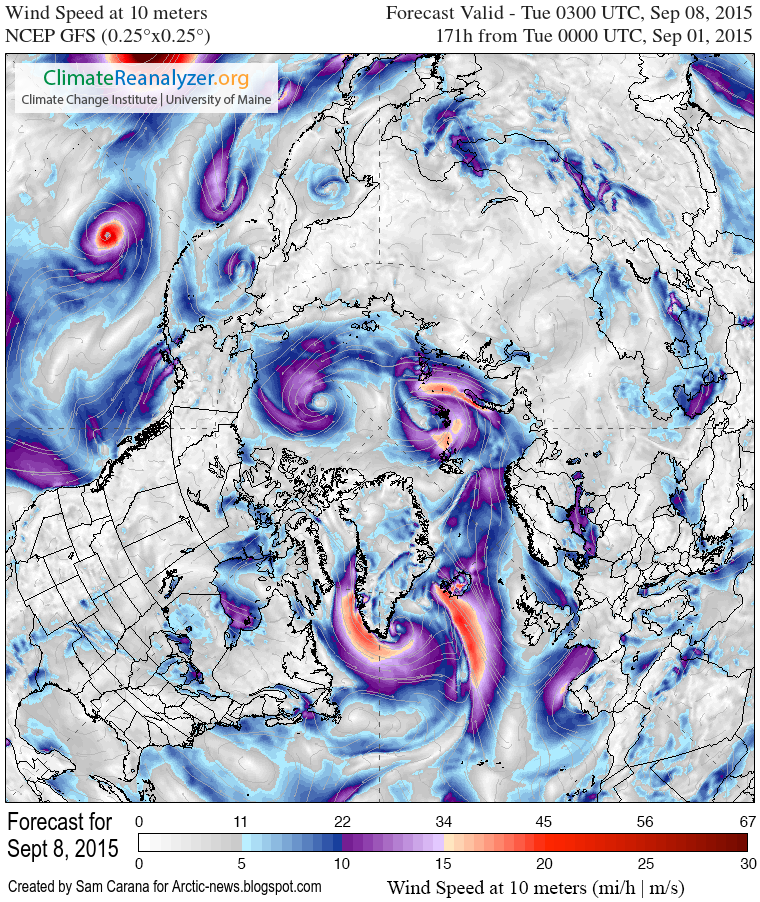
These typhoons are headed in the direction of the Arctic. The Climate Reanalyzer forecast for September 8, 2015, below shows typhoons in the Pacific Ocean close to the Arctic Ocean, as well as strong wind over the Arctic Ocean.


The situation is dire and calls for comprehensive and effective action, as discussed in the Climate Plan.

Thick sea ice is virtually absent compared to the situation in the year 2012 around this time of year....
Posted by Sam Carana on Tuesday, September 1, 2015

Selasa, 18 Agustus 2015

Disappearance Of Thick Arctic Sea Ice

[ view full image at facebook ]


Arctic sea ice is in a horrible state. On August 16, 2015, Arctic sea ice extent was 5.786 million square km, the smallest extent on record for this time of year except for the years 2007, 2011 and 2012, as illustrated by the image on the right.

The situation today is even worse than one might conclude when looking at sea ice extent alone. Thick sea ice is virtually absent compared to the situation in the year 2012 around this time of year, as illustrated by the image below comparing sea ice thickness on August 16, 2012 (left) with August 16, 2015 (right).


The ice used to be over 4 m thick, or over 13 ft thick, north of Greenland and the Canadian Archipelago. This thick multi-year ice has been a feature of the Arctic sea ice for over 100,000 years. It used to be there all year long, unlike the thinner ice that could melt away entirely during the melting season.

The disappearance of this thick multi-year ice is a major development. Why? Until now, the thicker multi-year sea ice used to survive the melting season, giving the sea ice strength for the next year, by acting as a buffer to absorb heat that would otherwise melt away the thinner ice. Without multi-year sea ice, the Arctic will be in a bad shape in coming years, and huge amounts of heat that would otherwise go into melting the ice will instead be warming up the Arctic Ocean, further accelerating warming of its waters.

Absence of thick sea ice makes it more prone to collapse, and this raises the question whether the sea ice could collapse soon, even this year. Sea ice works like a mirror. Without sea ice, sunlight that was previously reflected back into space, will instead be absorbed by the Arctic. Albedo changes in the Arctic alone could more than double the net radiative forcing resulting from the emissions caused by all people of the world, as calculated by Prof. Peter Wadhams back in 2012.

Furthermore, there is a danger that loss of the sea ice will weaken the currents that currently cool the bottom of the sea, where huge amounts of methane may be present in the form of free gas or hydrates in sediments. This danger is illustrated by the image below by Reg Morrison, from an earlier post.


Absence of sea ice also goes hand in hand with opportunities for storms to develop over the Arctic Ocean. Such storms could push the remaining sea ice out of the Arctic Ocean. Such storms could also mix surface heat all the way down to the seafloor, where methane could be contained in sediments.

As described in an earlier post, sea surface anomalies of over 5 degrees Celsius were recorded in August 2007 (NOAA image right). Strong polynya activity caused more summertime open water in the Laptev Sea, in turn causing more vertical mixing of the water column during storms in late 2007, as described in this study, and bottom water temperatures on the mid-shelf increased by more than 3 degrees Celsius compared to the long-term mean.

Indeed, the danger is that heat will warm up sediments under the sea, containing methane in hydrates and as free gas, causing large amounts of this methane to escape rather abruptly into the atmosphere.

The image on the right, from a study by Hovland et al., shows that hydrates can exist at the end of conduits in the sediment, formed when methane did escape from such hydrates in the past.

Heat can travel down such conduits relatively fast, warming up the hydrates and destabilizing them in the process, which can result in huge abrupt releases of methane.

Since waters can be very shallow in the Arctic, much of the methane can then rise up through these waters without getting oxidized. As the methane causes further warming in the atmosphere, this will contribute to the danger of even further methane escaping, further accelerating local warming, in a vicious cycle that can lead to catastrophic conditions well beyond the Arctic. For additional feedbacks in the Arctic, see the feedbacks page

At the same time, ocean heat is at a record high and there's an El Niño that's still gaining strength. This ocean heat is likely to reach the Arctic Ocean in full strength by October 2015, at a time when sea ice may still be at its minimum. The image below shows sea surface temperatures on August 16, 2015 (left) and anomalies (right).


How warm is the water entering the Arctic Ocean? Merely looking at sea surface temperatures could make one overlook the full extent of the predicament we are in. Ocean heat traveling underneath the sea surface can be even warmer than temperatures showing up at the surface. This is illustrated by the image below indicating that on August 16, 2015, warm water emerged at the sea surface near Svalbard with temperatures as high as 14.9°C or 58.7°F, a 9.5°C or 17.1°F anomaly.


There still is about a month to go before sea ice can be expected to reach its minimum, at around half September 2015, while sea currents will continue to carry warmer water into the Arctic Ocean for months to come.

The situation is dire and calls for comprehensive and effective action, as discussed in the Climate Plan


Thick sea ice is virtually absent compared to the situation in the year 2012 around this time of year, as illustrated by...
Posted by Sam Carana on Tuesday, August 18, 2015

Minggu, 15 Maret 2015

Strong Winds And Waves Batter Arctic Sea Ice

As Earth warms, the intensity of storms is rising across the globe. At least eight people died in Vanuatu, as it was hit by Cyclone Pam. "It hit Port Vila at an incredible 340 kilometres an hour", mentions a recent news report. The left part of the image below shows Cyclone Pam reaching speeds as high as 144 kilometers an hour (89.48 mph, green circle) on March 12, 2015, 1500Z, while three further cyclones feature on the Southern Hemisphere. 


At the same time, on the Northern Hemisphere, winds reached speeds as high as 101 km/h (62.76 mph, bottom green circle), 120 km/h (74.56 mph, middle green circle) and 112 km/h (69.59 mph, top green circle), as shown on the right part of above image.

The image on the right shows winds with speeds as high as 125 km/h (77.67 mph) batter the coast of Greenland on March 13, 2015 (green circle).

The image below shows strong winds moving from the North Atlantic into the Arctic Ocean on March 13, 2015. 


The video below, with cci-reanalyzer.org forecasts for March 13 - 20, 2015, shows strong winds battering the Arctic Ocean at both the Pacific and Atlantic ends.


The combination image below shows winds around Greenland (top) and winds penetrating the Arctic Ocean (bottom).


Waves as high as 41.5 ft (12.65 m) were recorded between Svalbard and Norway on March 13, 2015 (green circle on the left part of the image below), while waves as high as 23.13 ft (7.05 m) were recorded close to the edge of the sea ice on March 15, 2015 (green circle on the right part of the image below).


The updated image below shows waves higher than 10 m (33 ft) near Svalbard close to the edge of the sea ice on March 16, 2015 (green circle).


Meanwhile, it more and more looks like the 2015 sea ice extent maximum was reached on February 25, as illustrated by the image below.


The image below (added later, ed.) shows Arctic sea ice area up to March 18, 2015 (top), and Arctic sea ice extent up to March 20, 2015 (bottom). Briefly, the difference between area and extent could be compared to Swiss cheese. Area is the cheese without the holes, while extent measures the cheese in addition to the holes. For more on this, see this NSIDC FAQ.


Strong winds can cause high waves that can break up the sea ice. At the same time, strong winds can speed up currents that push sea ice out of the Arctic Ocean, while bringing warmer water into the Arctic Ocean, as illustrated by the image below.


The image below shows sea surface temperatures of 20.9°C (69.62°F, green circle left) recorded off the coast of North America on March 14, 2015, an anomaly of 12.3°C or 26.54°F.

[ click on image to enlarge ]
The image below shows sea surface temperature anomalies in the Arctic Ocean on March 15, 2015.


The big danger is that warm water will trigger further releases of methane from the seafloor of the Arctic Ocean. Peak daily methane levels recorded in early 2015 averaged a very high 2370 parts per billion, as illustrated by the image below.


Natalia Shakhova et al. estimate the accumulated methane potential for the Eastern Siberian Arctic Shelf (ESAS, rectangle on image right) alone as follows:
- organic carbon in permafrost of about 500 Gt;
- about 1000 Gt in hydrate deposits; and
- about 700 Gt in free gas beneath the gas hydrate stability zone.

Hydrates can become destabilized by pressure changes that can be caused by earthquakes and resulting shockwaves and landslides, or that can be caused by wild temperature swings.

Hydrates can also become destabilized by a small temperature rise that can be caused by influx of warmer water from outside the Arctic Ocean or by warm surface water being mixed down by storms.

Waters in the ESAS are quite shallow, averaging less than 50 m depth over its 2x10ˆ6 km2 area, while methane hydrates in the ESAS can exist at depths as shallow as 20 m.

Where heat is able to penetrate the sediment along cracks, some hydrate destabilization can occur, which in turn can trigger larger destabilization, as methane escaping from a hydrate expands to 160 times its earlier volume; this explosive expansion can cause further destabilization of sediments containing methane in the form of hydrates and free gas.

The situation is dire and calls for comprehensive and effective action, as discussed at the Climate Plan blog.


Jumat, 06 Maret 2015

March 4, 2015 - Arctic Sea Ice Extent Hits Record Low

Sea surface temperature anomalies as high as 12°C (21.6°F) recorded off the east coast of North America have been described earlier, in he post 'Watch where the wind blows'. The Jet Stream reaching high speeds has also been described earlier, in the post 'Climate Changed'.


As feared, this is pushing warm water, water vapor and air from the North Atlantic into the Arctic Ocean. The three images below show forecasts for March 8, 2015, of - from top to bottom - the jet stream, surface winds and temperature anomalies.


Above image shows that the Arctic is forecast to reach a temperature anomaly of more than +4 degrees Celsius (more than +7 degrees Fahrenheit) on March 8, 2015, with temperature anomalies at the top end of the scale forecast for most of the Arctic Ocean.

On March 4, 2015, Arctic sea ice extent hit a record low for the time of the year, as illustrated by the image below.


As the March 5, 2015, Naval Research Laboratory image on the right illustrates, there is little scope for Arctic sea ice extent to grow over the next few weeks, since the only areas where it could possibly expand would be the Pacific and the North Atlantic, the very areas that are under pressure from ocean heat and high surface temperatures.

In other words, the situation looks set to deteriorate further.

Huge amounts of heat are still going into melting the sea ice. Furthermore, the sea ice is still able to reflect a lot of sunlight back into space. With continued demise of the snow and ice cover, more and more heat will be absorbed in the Arctic.

The big danger is that warm water will trigger further releases of methane from the seafloor of the Arctic Ocean. Peak daily methane levels recorded in early 2015 averaged a very high 2372 parts per billion, as illustrated by the image below.


Methane extent has been especially high over the Arctic Ocean. The images below are from the earlier post 'Temperature Rise'. The post added that, as the Gulf Stream keeps carrying ever warmer water into the Arctic Ocean, methane gets released in large quantities, as illustrated by the images below showing high methane levels over the East Siberian Arctic Shelf (red oval left) and over Baffin Bay (red oval right) with concentrations as high as 2619 ppb.

click on image to enlarge
The images below show methane levels on Jan 25 (top), and Jan 26, 2015 (bottom).


Update:
Meanwhile, Arctic sea ice extent as reported by NSIDC.org reached a new record low for the time of the year with 14.358 million square km on March 4, 2015, and another record low with 14.308 million square km on March 7, 2015.

Temperature anomaly for the Arctic on March 8, 2015 (daily average) was even higher tha forecast, at +4.26 degrees Celsius, with peaks at +4.37 degrees Celsius.


High waves were registered in the North Atlantic on March 7, 2015, moving into the Arctic Ocean and causing waves more than 4 m high close to the edge of the sea ice on March 8, 2015.


The situation is dire and calls for comprehensive and effective action, as discussed at the Climate Plan blog.